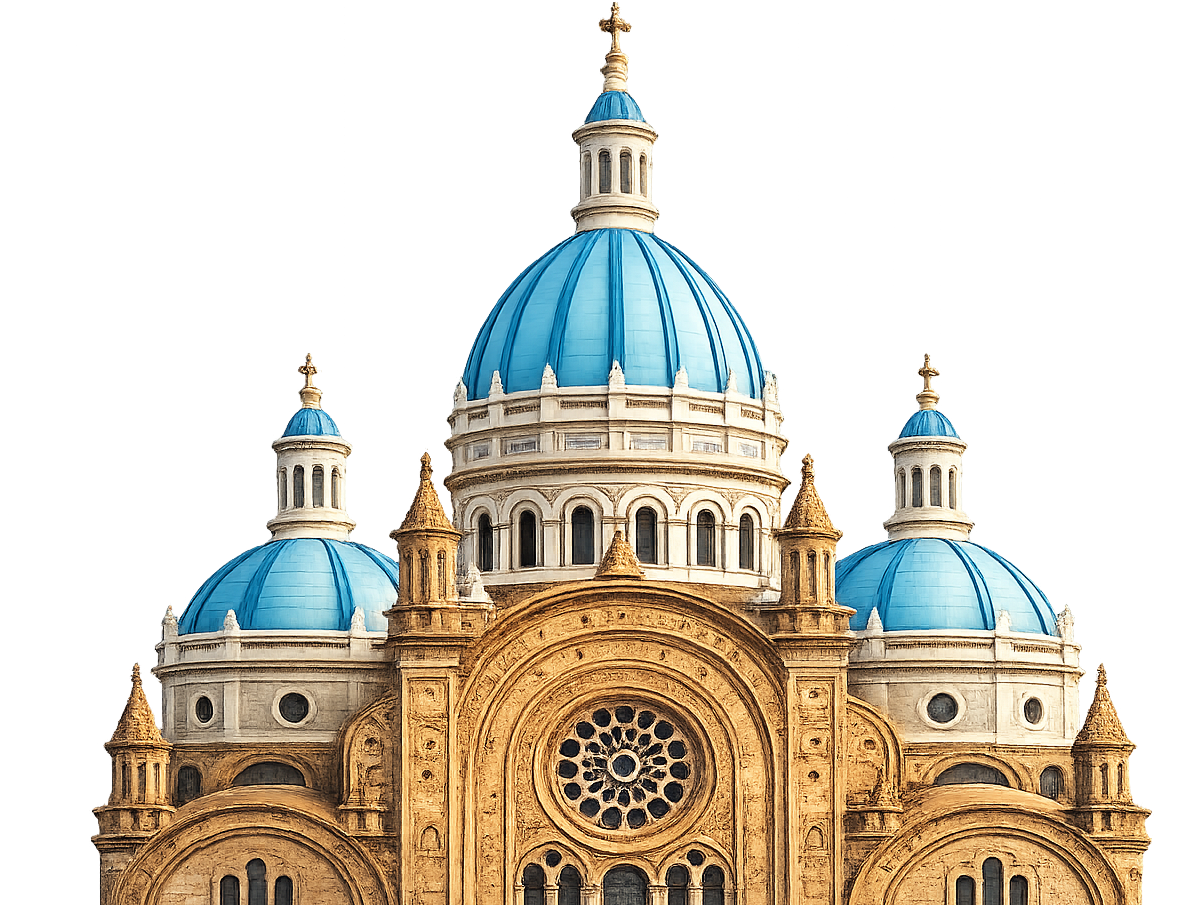
Cuenca, Ecuador’s crown jewel of heritage, captivates visitors not only with its cobblestone streets and winding rivers but also with a dense concentration of religious architecture that historically earned it the nickname of the "Little Vatican".
For digital nomads and guests staying at the NASS Hotel Chain, decoding the map of its temples is an incredibly fascinating journey. How many churches actually exist? Which ones hide the deepest secrets, the highest costs, or the oldest histories? Here is an in-depth breakdown of the religious wealth within this southern Andean city.
How many churches are there in Cuenca?
Local urban legend often claims there is a church for every day of the year. However, historical and property registries provide a more precise count: within the Historic Center of Cuenca there are exactly 17 major temples, while across the entire canton the number exceeds 50 religious structures. This high concentration transforms the city into an open-air, living museum of Baroque, Gothic and Neoclassical art.
The oldest: San Blas Church
While many mistake the Old Cathedral (El Sagrario) for this record, historical documentation officially grants the title to the San Blas Church. The laying of its first stone dates back to May 3, 1557, just a month after the Spanish foundation of Cuenca.
It originally began as a modest adobe and thatch-roofed chapel built for the indigenous population. Today, following three major reconstructions, it still preserves invaluable archaeological foundations.
The most expensive: Cathedral of the Immaculate Conception
In terms of scale, execution time and raw materials, the New Cathedral holds the financial and architectural record. Its construction began in 1885 under the architectural plans of the Redemptorist brother Juan Bautista Stiehle and took more than 80 years to complete, opening officially in 1967.
- High altar covered entirely in gold leaf.
- Interior columns crafted from marble imported from Carrara (Italy).
- Majestic stained-glass windows brought directly from Germany and Belgium.
Its infrastructural and heritage value is incalculable.
The most enigmatic: Temple and Monastery of Las Conceptas
Founded at the end of the 16th century, this complex embodies the mystery of colonial cloistered life. The Las Conceptas Church and its adjoining convent have shielded underground crypts, cloistered passageways and one of the most private collections of religious art in Latin America for centuries.
The stone and bahareque walls of this temple guard legends of vows, penances and dowries from Cuenca’s oldest noble families, who vanished behind its iron grates never to be seen again.
The most touristic: the blue domes of the New Cathedral
Without question, the New Cathedral dominates tourist foot traffic. The main highlight for visitors is the ascent to the towers — a route that allows travelers to walk alongside its iconic blue domes made of tiles imported from the Czech Republic, and enjoy the most photographed panoramic viewpoint over Calderón Park.
Just a few metres away, the flower market right next to the El Carmen de la Asunción church completes this essential tourist circuit.
Curious facts about Cuenca’s ecclesiastical circuit
- The tower calculation error — the New Cathedral lacks the two frontal bell towers that were originally projected. The architect Juan Bautista Stiehle made a mathematical miscalculation: if the bell towers were built to their planned height, the entire structure would collapse due to excessive weight on the foundations. Consequently, they were left intentionally truncated, giving the building its unique, distinct silhouette.
- Inca stones in Christian temples — when visiting the Old Cathedral (El Sagrario), if you look closely at the base of its exterior walls, you can identify perfectly carved pillowed ashlar stone blocks. These stones were excavated directly from the nearby ruins of Tomebamba (the Inca city over which Cuenca was founded) and repurposed by Spanish conquerors.
- The wooden Sacred Heart — the Todos Santos Church (another of the city’s oldest temples, located near NASS Casa del Águila) stands out because its original structure and its iconic tower featuring the Sacred Heart of Jesus were carved entirely out of wood in the 1920s, breaking the brick-and-lime standard of that era.
NASS connectivity: your cultural and historical launchpad
The strategic placement of the NASS Group properties allows you to explore this route of faith and history with absolute ease:
- NASS Casa del Águila (Mariscal Sucre 13-56) — housed in a fully restored 1804 patrimonial property, located a mere two blocks from the historic San Sebastián Square and Church.
- NASS del Sur (Benigno Malo and Mariscal Lamar) — diagonally from the local artisan plaza and just one block from the commanding New Cathedral.
- NASS Central Garden (Mariano Cueva and Gran Colombia) — three blocks from the central axis of these historic temples, allowing for a seamless return to corporate comfort after long walking and photography tours.
To discover more corners of Cuenca, continue with our local guide.